Robot to goat to cow
“To you, Mr. Stevens, I present the greatest innovation in the history of dairy farming. Behold... Lacey.”
The novice farmhand swung open the stable door, revealing behind it a figure clad in plastic and fabric, closely resembling a young country woman.
“Hey Lacey,” Mr. Hollowell began. “Perform task ‘Close stable doors.” At his command, the machine rose, stepping its way out of its compartment, shutting the wooden hatch leading in before checking the rest of the barn for open stables. It found one and solved the issue, returning when the task was complete.
“Gotta say, we’re off to a creepy start Mr. Hollowell. I take it she manages the barn?”
“She does much more than manage the barn!” replied the rancher emphatically. “Take a gander. Hey Lacey? Perform task ‘Drive Vehicle: F-250’ and bring it to my location.” The robot turned around, speeding out of the barn like Usain Bolt, only to return in the driver’s seat of a new Ford pickup right outside the barn. Stopping the truck’s engine, she stepped down from its crew cab, reassuming its steadfast boost ion beside Mr. Hollowell.
Mr. Stevens was now thoroughly impressed by the electronic worker; it seemed to be able to perform any task a human could. “Wow,” he reacted. “This is a whole new definition of the term ‘motor skills’.”
Mr. Hollowell chuckled. “You could say that for sure. But its primary purpose is dairy farming. See, with bots like Lacey, you simply don’t need as many goats or cows. She can make the milk herself using the gases inside her molecular synthesis chamber.”
Taken aback, Mr Stevens quickly grew skeptical. “Wait a minute. A robot, making real, safe-to-drink milk. You’re joking.”
“Does it sound like I’m jokin’?”
“Even if it can, how are you gonna extract that liquid?”
“Ha! It’s easy. She’s compatible with the milking apparatuses we already got installed. Hey Lacey! Begin ‘goat’s milk production’.”
In response to the farmer’s prompt, Lacey dropped to all fours and began to reconfigure its body. First, the false outfit it wore was unzipped down the middle, a thin arm sliding down its back and collecting it at the droid’s torso area, where it quickly retracted to reveal protective plates, joints, and some wiring. From here its hips and shoulders slid out from its collar and pelvis, exposing more plastic plates and widening the bot’s stance. Shortening its arms and legs, its hands and feet folded away into its limbs, extending in their place two pairs of hardened hooves. Lacey then announced that it was “awaiting leg covers.”
Mr. Hollowell quickly retrieved four sleeves, each lined with foam on the inside and white hairs facing out. Carefully but briskly, he affixed them to the machine’s compressed legs, at which point it resumed its conversion. Each leg flexed once to check the fit while the main torso plates on the bot tilted ajar, leaving just enough clearance to allow more plates to fold from under them and into their proper place. This redefined Lacey’s central shape, leaving it very goatlike with ignorance to color and texture.
The womanly head that sat atop Lacey’s shoulders parted down the middle and split into two halves, hiding against joints on the robot’s frame and leaving an attachment point in its place. To the surprise of Mr. Stevens, the head of a goat suddenly swung down overtop of the anchor, to which it attached itself. Its neck was mostly plastic and exposed metal, but Mr. Stevens had a strong hunch that that would be rectified in due time.
In a similar fashion, a bobbed, hairy tail flipped into place at Lacey’s rear end. Then as a penultimate step, four rods protruded from the spinal line and two from the neck portion, revealing with them sheets of faux goatskin that, with the guidance of the aforementioned rods, cover each and every robotic element of the transforming machine, leaving only a pit between Lacey’s back legs open.
This pit was to be filled however, filled by two rapidly inflating silicone structures that fully occupy it and bulge out to all sides. From the oblong sacs, which now look just like a goat’s udder, grow a total of two long teats. “Beginning goat’s milk production,” Lacey spoke in its feminine, bionic voice, signaling the end of what was possibly the longest two minutes of Mr. Stevens’ life; before him was something that did not at all resemble any sort of robot. In fact, there were no visual details present that would alert anyone to the presence of something mechanical. This robot, in front of Mr. Stevens, was a goat.
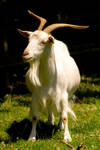
“I can tell by that look on yer face that you’re flabbergasted,” pointed out Mr. Hollowell. “Hell, I was too the first time I saw this in action. Pretty damn remarkable, this thing’s a prototype, and look at what it can do.”
“I... see... yeah, Lacey looks just like any other adult female goat. Pretty amazing if you ask me. But how do you milk it?”
“Well, you can hand-squeeze, even though that’ll give ‘er away. Obviously she don’t have a real udder, so the designers went with silicone. Other than that, you can hook Lacey up to a milk machine and let it do the work for ya, which is the main purpose behind bots like these.”
Mr. Stevens raised an eyebrow.
“What I mean is, while dairy farms like this one lose the need for actual livestock, this’ll ease the transition from stables of cows and goats to compartments of lactose synthesizers and milk generators.”
“Oh yeah, now that you mention, what about cow’s milk? That’s much more frequently consumed.”
“I thought you’d never ask. Hey Lacey? Begin ‘cow’s milk production’.”
The robot was quick to reply: “To begin cow’s milk production, remove leg covers.” Mr. Hollowell did as he was told. As soon as he did, Lacey’s udder went limp, only for it to be slurped up into the pit between the back legs. Its diminutive tail rotated into hiding after its hairy pelt tucked away within its body. An assembly of rods then arrived at its head, each pair attached to a fabric of some sort. The fabric was gingerly slipped around the goat’s visage, the rods working alongside Lacey’s facial servos to fit it, eventually leaving the machine with a convincing cow cranium and an ear tag.
It didn’t need to replace its hooves as they already seemed bovine enough. But its stance did widen a little extra and its arms drastically elongated, giving it a certain tallness that topped both Mr. Stevens and Mr. Hollowell’s heights. It announced that it was “awaiting leg covers,” which Mr. Hollowell was quick to install. Just like when it became a goat, Lacey checked the covers’ fit and used its plates to reshape its torso. Larger, slightly more curved plates corrugated into place in exchange for the smaller, more angular ones that were previously displayed. The droid stretched its torso in the process to perfect its size; the size of a dairy cow.
Six rods returned, delivering to Lacey the fabrics that would fit around its body as faux hide. First, the plastic shells tilted open along its back and neck to reveal slots. From the slots came black and white sheets, guided into full extension by the rods. Then, just after Lacey’s tail protruded from its backside and into view, the rods curled at their joints and properly dressed it in its new skin. To finalize the transformation, a cow’s udder ballooned into size between its legs, growing its teats in tow.
“Beginning cow’s milk production,” proclaimed the droid, now indistinguishable from a common Holstein cow.
Mr. Stevens clapped his hands in amazement. Venturing up to Lacey, he gave it a thorough visual, and found nothing that would alert anyone to the presence of a machine where Lacey stood. “I have to admit, I just don’t get it. This is magic is what it is; how does that bot look just like any other cow?”
“Lotta research,” explained Mr. Hollowell crassly, “and precision engineering. We farmers got brains somewhere in here.” He pointed to his head and grinned.
Mr. Stevens rubbed a hand along Lacey’s ribs, discovering that texture is where the similarities end, even though the robot bellowed a textbook “mmmoooooo” in response to the touch. “Doesn’t really feel all that cowlike though. Eh, shouldn’t matter. This contraption deserves an Oscar for its looks.”
“She makes some scur-rumptios milk, cream and butter too. Another farm out in Wisconsin says they got some people taste-testin’ the goat cheese this puppy can help whip up, and their predictions were blown away by how many people liked it,” stated Mr. Hollowell proudly.
“Well, your farm’s Red Barn cheese is already pretty good, I’ve had some myself,” Mr. Stevens replied. “Maybe Lacey’s milk can improve on that too?”
“I bet it can!”
“How many farms have these robots as of now?”
“I think just ten-er-so. But there’ll be more gettin ‘em in the years to come. Remember, we’re only at the prototype stage. I didn’t build these things; I just volunteered to test one, and I was selected.”
“You’re pretty lucky then,” chuckled Mr. Stevens.
“Heh. I guess I am. Here’s to happy farmin’.”