Jack had always been obsessed with time.
As a kid, it started with movies—flashy machines, glowing portals, dramatic warnings about paradoxes. As he got older, the obsession matured into books, forums, equations scribbled across notebooks, and late nights watching obscure documentaries about theoretical physics. Time travel wasn’t just entertainment to him; it was a promise. Proof that the universe still had mysteries left to crack.
By the time he was twenty-eight, Jack had poured four straight years into one singular goal: building a time machine.
It cost him friendships, sleep, and more than one stable job. His apartment looked less like a home and more like a workshop, wires crawling along the walls, half-built components stacked beside empty coffee cups. Failure was constant—burnt circuits, melted parts, and one memorable explosion that took out his power for an entire weekend. But Jack kept going.
And then, one night, impossibly, it worked.
The machine hummed with a low, steady vibration, lights pulsing in rhythmic patterns that made his heart race. Readings stabilized. No alarms. No sparks. Just… readiness.
He didn’t hesitate.
Jack set the coordinates to a specific date in the early 1970s—the week his mother had left home for college. He’d grown up hearing stories about how wild and carefree she’d been back then, nothing like the cautious, practical woman who raised him. He wasn’t planning to interfere. He just wanted to see. To observe.
He stepped into the chamber, took a shaky breath, and closed his eyes.
The world lurched.
There was no dramatic flash, no sense of movement through space—just a sudden, crushing weight pressing down on him from all sides. His stomach twisted. His thoughts blurred. When the sensation finally stopped, Jack opened his eyes.
Something was wrong.
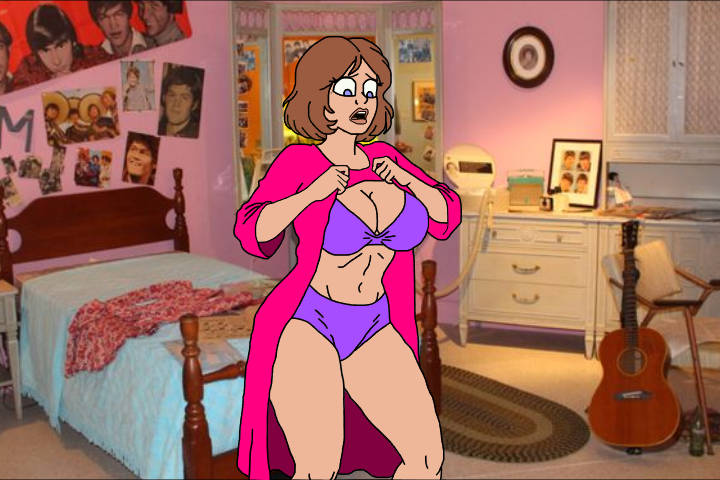
The first thing he noticed was his body. His balance felt off, his center of gravity unfamiliar. His chest felt… heavy. Uncomfortably so. He looked down and froze.
A soft pink nightgown draped over a body that was not his. The fabric hung differently, stretched where it shouldn’t be. His hands—smaller, smoother—trembled as he lifted the gown slightly, revealing curves where there had never been any before.
“No. No, no, no—” he muttered, his voice cutting off abruptly.
It wasn’t his voice.
It was higher, softer, unfamiliar in a way that sent pure panic through him.
His hair brushed against his shoulders as he moved, long and thick, falling forward into his line of sight. Heart pounding, Jack staggered toward a nearby mirror.
The reflection staring back at him stole the air from his lungs.
It wasn’t a twenty-eight-year-old man with tired eyes and stubble.
It was an eighteen-year-old girl.
Young. Bright-eyed. Nervous-looking. And unmistakably familiar.
It was his mother.
Not the version he knew—older, worn down by years of responsibility—but a younger her, untouched by the future, standing at the edge of adulthood. Her face. Her posture. Even the small birthmark near the collarbone.
Jack’s knees buckled, and he had to grab the dresser to stay upright.
“My… mom,” he whispered, hearing her voice say the words.
Memories that weren’t his brushed against his thoughts—names, feelings, half-formed worries about classes, roommates, and the future. They weren’t fully formed yet, but they were there, like echoes trying to push their way in.
That’s when it hit him.
The machine hadn’t sent his body back in time.
It had sent his mind.
His consciousness—his memories, his identity—had been dropped into his mother’s younger body, decades before he was ever born. The original Jack still existed somewhere in the future, but this Jack was now trapped in the past, living inside the woman who would one day give birth to him.
And the time machine?
Gone.
No hum. No portal. No way back.
Jack sat on the edge of the bed, staring at unfamiliar hands resting in his lap, his thoughts racing faster than he could keep up. If he changed too much, would he erase himself? If he made different choices, fell in with different people, took a different path—would his life unravel before it ever began?
Yet the temptation gnawed at him.
He knew how hard her life would become. He knew the mistakes, the regrets, the quiet disappointments she never talked about. He knew how much she sacrificed.
For the first time, Jack wasn’t just studying time travel.
He was living inside its greatest paradox.
Epilogue
Years passed.
To the world, she was just another woman who went to college in the seventies, grew up, made choices, and lived a life that looked mostly ordinary. To Jack, every day was a careful balancing act.
He let some things happen exactly as they were supposed to. Certain friendships. Certain meetings. Certain decisions he knew were critical threads in the tapestry of time.
But not everything stayed the same.
He was kinder to himself—to her. More confident. Less afraid to speak up. He nudged her life just enough to soften the hardest edges, to avoid a few painful detours without tearing reality apart.
And one day, years later, holding a newborn baby in his arms, Jack felt a strange, quiet peace settle over him.
He didn’t remember choosing the name—but when he heard it spoken aloud, his heart tightened.
Jack.
In that moment, he understood.
Time didn’t just move forward. It folded. It repeated. It healed itself in ways no machine ever could.
Jack never returned to his own body.
But he stopped trying to escape the past.
Because in living his mother’s life, carefully and compassionately, he ensured his own future—and finally learned that time travel wasn’t about changing history.
It was about understanding it.