Amber’s favorite Louboutins clicked sharply against the marble floor as she strode through the crowded campus plaza. She ignored the whispers trailing behind her like cheap perfume. Her phone buzzed incessantly—another party invite, another desperate DM.
Her heel caught on something lumpy near the library steps. She stumbled, biting back a curse as she regained her balance. There, half-hidden beneath a crumpled flyer for the robotics club, lay a pair of glasses—thick, ugly frames with lenses like the bottoms of soda bottles, smudged with fingerprints.
Amber snorted, picking them up between thumb and forefinger as though handling contaminated evidence. “Gross,” she muttered, already picturing some sweaty comp-sci kid panicking over his lost specs. On impulse, she slid them onto her face, hunching forward in mockery for her imaginary audience.
“W-well, a-actually,” she stammered in a nasal whine, puffing out her cheeks, “th-the quadratic formula requires—”
Her voice faltered. The world swam into an almost painful focus—every blade of grass distinct, the seams between bricks deep as canyons.
A wave of dizziness hit her, thick as swamp air. Her scalp prickled; the perfect honey-blonde extensions felt coarse and heavy, like cheap yarn glued to her head. She gasped, and the sound hitched wetly in her throat, emerging as an involuntary snort that made her cheeks burn.
Her designer silk blouse tightened alarmingly across her midsection, seams groaning as if inflated from within. Panic fluttered in her chest—sharp, frantic, alien. What was happening?
Her trembling hands flew to her face. Cold, thick frames pressed against a suddenly wide, fleshy nose. Braces snagged her lower lip, the sour taste of metal filling her mouth. When she tried to speak, the word “No!” came out slurred and thick—“Nuh-gwah!”—as if her mouth couldn’t form it properly.
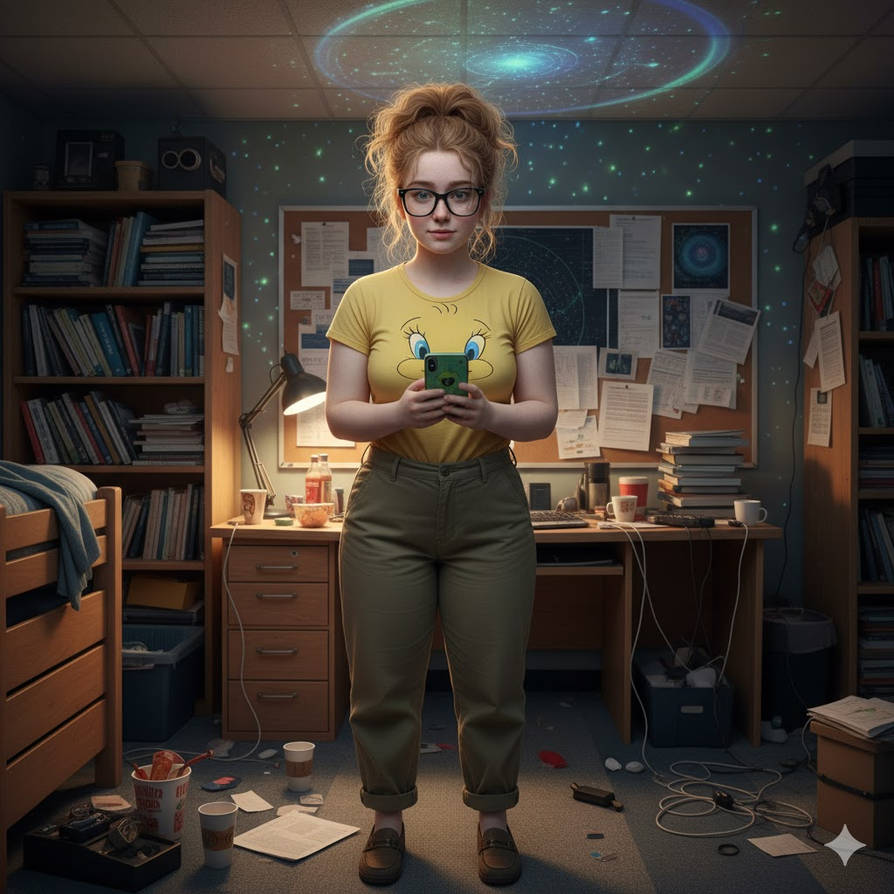
Below, her tailored pencil skirt split audibly at the hip, replaced by baggy, pleated khakis that swam around her thickening thighs. Her Louboutins vanished, replaced by scuffed orthopedic loafers squeezing swollen feet.
A second dizzy wave crashed over her, pulling a wet snort from her nostrils. She fumbled for her phone—her lifeline—but her fingers were clumsy, alien. The sleek device slipped, bouncing off her shoe. As she bent to retrieve it, a loud, involuntary belch erupted, acidic and sharp. Mortification flooded her cheeks crimson as nearby students snickered.
“S-sorry,” she stammered, the words thick and halting, her tongue wrestling with braces and saliva. The cool confidence that once armored her was gone, replaced by fluttering panic—like moths trapped behind glass.
Stumbling sideways, she collided with a stone bench. Pain shot through her hip as her unbalanced frame pitched forward, uneven breasts straining against a stretched, faded Tweety Bird T-shirt. Her thick lenses fogged with tears, magnifying every pore on the mocking faces around her.
Asthma tightened her airways; each wheezing gasp tasted of old library dust. One knee scraped raw against the concrete, and her baggy khakis slid dangerously low, exposing the worn elastic of polka-dot underwear. She scrambled to cover herself, fingers trembling over the unfamiliar swell of her belly.
Inside her head, a scream echoed—Amber, say something cool!—but the thought dissolved into panicked static. “I-I’m s-s-s—” The stammer locked her jaw. Spittle sprayed across her chin.
Nearby, Brad Thompson, the quarterback she’d hooked up with twice last semester, snorted. “Who let the circus escape?” His buddies cackled.
Heat flooded her face. Shame prickled like a thousand needles. She crossed her arms over her chest to hide the uneven bulge beneath thin cotton, only to flinch when her braces tore her lip.
A sharp, sulfurous smell bloomed in the air. Heads turned. Amber squeezed her thighs together, horrified. Not me. Please not me. But a second, wetter sound escaped—a muffled fart rustling through the khakis.
The laughter doubled. “Dude, lay off the cafeteria chili!” Brad called, waving a hand.
Tears blurred her vision. She blinked hard, smudging greasy fingerprints across her thick lenses. Her lungs tightened; each wheezing gasp tasted like chalk dust and humiliation. Where was her inhaler? Where was Amber?
She hunched deeper, shoulders rounding instinctively. The world felt crushing—every whisper, every rustle amplified through the cheap plastic frames. Why can’t I speak? Why is everything fuzzy and sharp at once?
A familiar buzz vibrated against her thigh. Her phone! Hope flickered. She jammed a trembling hand into her pocket and pulled it out—only to stare in confusion. The glittering rhinestone case was gone. In her palm sat a cracked, rubbery protector patterned with faded pixelated aliens. A cheap burner phone blinked dimly inside.
She swiped at it, but her thumb slipped on the greasy screen. Instead of Instagram, a spreadsheet shimmered into view—equations and formulas she’d never understood, suddenly glaringly clear. Her mind latched onto them like a lifeline.
“Th-the covariance matrix…” she mumbled thickly, saliva pooling behind her braces. The jargon felt strangely comforting, solid.
A shadow fell over her. Professor Aris Thorne from the Astrophysics department stood above, a stack of star charts in his hands. His sharp gaze, magnified by his own glasses, flicked over her faded Tweety Bird shirt and the equations glowing on her phone.
“Impressive,” he murmured. “You’ve accounted for gravitational lensing variables. Most undergraduates overlook that.” His tone held genuine curiosity, not mockery.
Amber—or whoever she was now—flinched, her uneven shoulders hunching further. A tiny, involuntary snort escaped her nostrils.
The alien-patterned phone trembled in her sweaty palm. The equations pulsed with impossible clarity. Her mind grasped them easily, the logic soothing against the raw sting of humiliation. “I-I… th-the redshift d-distortion,” she stammered. The words were halting, but correct.
Professor Thorne’s eyebrows lifted. “Indeed. Your insight is… unexpectedly acute.” He handed her a flyer. Astrophysics Tutoring Needed – Apply Now. Room 307.
His tone was curt, but the offer hung in the air like an unexpected lifeline.
Life as Phoebe Abernathy unfolded with quiet inevitability.
The faded Tweety Bird shirt and baggy khakis became her uniform. Her dorm room—once a minimalist showcase of designer labels—now overflowed with astrophysics textbooks and annotated star charts pinned haphazardly to peeling walls. The faint scent of microwave popcorn mingled with the metallic tang of her inhaler.
Her Louboutins were a distant dream, replaced by orthopedic loafers squeaking faintly on linoleum. The flutter of anxiety in her chest was now constant, punctuated by wheezing breaths and the occasional involuntary snort when flustered—especially near Professor Thorne, or any vaguely authoritative man.
Amber was gone. Phoebe remained. And somehow, against all reason, the stars finally made sense.
Mornings came quietly now. No more curated playlists blasting from a designer Bluetooth speaker, no more champagne brunches or influencer selfies framed against marble countertops. Instead, Phoebe woke to the soft wheeze of her own breathing and the faint hum of her dorm’s ancient mini-fridge.
Her alarm was always set for six, though she usually woke before it — nerves and routine doing the job better than any ringtone. She’d sit up, push her thick glasses into place, and fumble for her inhaler before shuffling across the floor in mismatched socks. The mirror above her desk still surprised her sometimes: pale skin, freckles, a crooked smile crowded by braces, and hair like dull straw frizzing around her face. But it no longer horrified her. It was simply… hers.
Her mornings smelled of instant coffee and dry-erase markers. She tutored freshmen in astrophysics now — the kind who once would’ve killed to talk to Amber for even a minute. They didn’t laugh at her. They respected her. She still stammered when nervous, but her explanations were sharp, confident in a way her old fashion critiques had never been.
Afternoons belonged to the observatory. There, beneath the slow rotation of the telescope dome, Phoebe felt something close to peace. The stars didn’t care that she snorted when she laughed or that her khakis never fit right. They just burned — brilliant, constant, eternal.
Evenings were quieter. Sometimes she scrolled through old photos stored in forgotten folders — filtered smiles, designer heels, girls with champagne flutes and fake laughter. She’d stare for a moment, then close the app before the ache could settle in. That girl looked like a stranger now, someone caught in a different orbit.
On Fridays, she met with Professor Thorne to review data. He never mentioned that first day — the transformation, the humiliation. But once, as she handed him a corrected equation, he’d smiled faintly and said, “You’ve come far, Miss Abernathy.”
And she had.
The campus whispers were gone now. No one watched her walk. No one cared what brand of shoes she wore. But as Phoebe stepped out of the observatory one night, the cool wind tugging at her Tweety Bird shirt, she glanced up at the stars and smiled — small, crooked, real.
Somewhere deep inside, the echo of Amber still stirred, but it no longer hurt. It was just another version of her, long since burned away — a faint redshift fading into the endless dark.