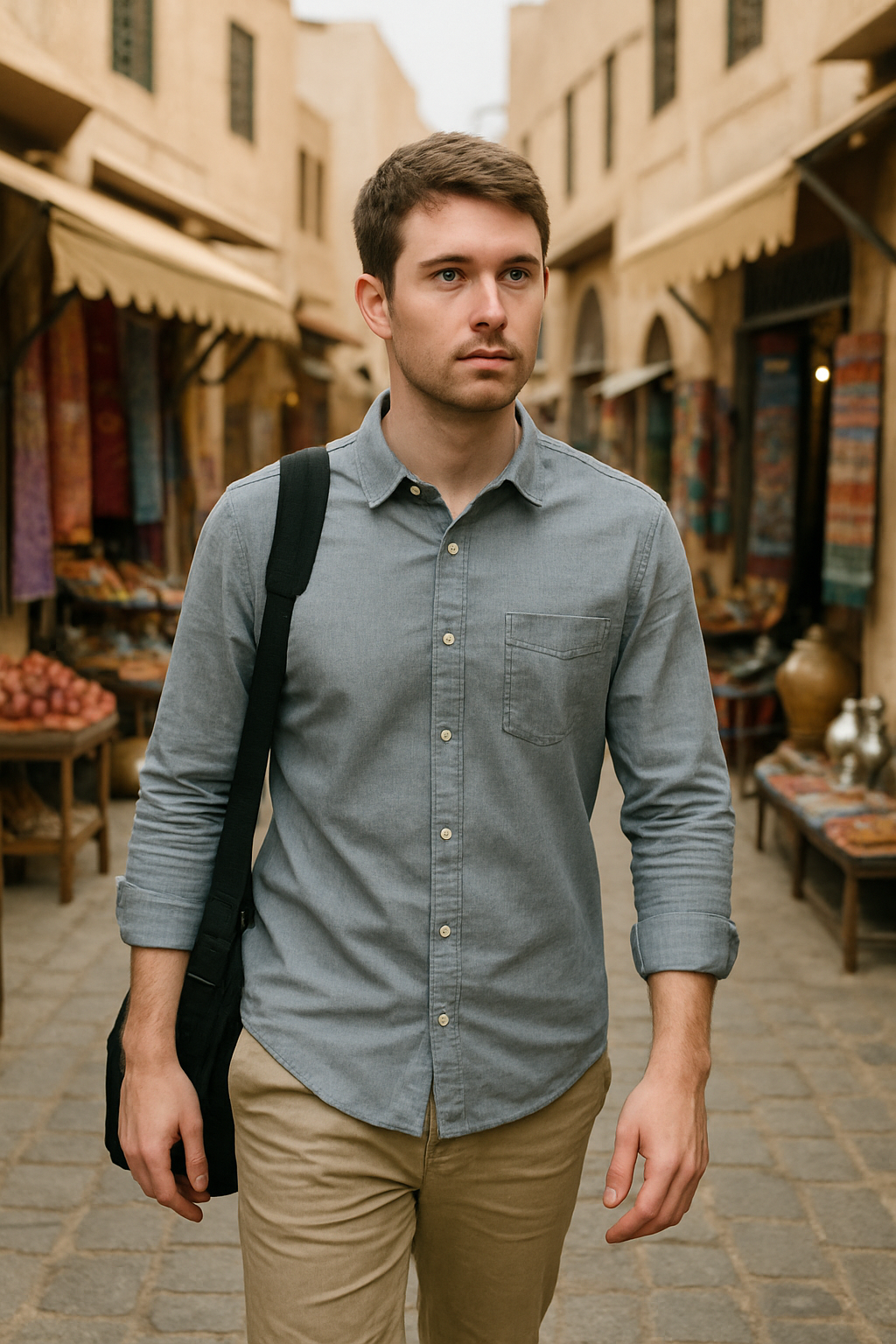
Jake adjusted the strap of his messenger bag as he stepped out of the hotel’s cool, air-conditioned lobby and into the heavy, dry warmth of the afternoon. The air carried a faint scent of spices, dust, and something sweet—maybe dates or honey pastries.
It was his third day in the city, and though most of it had been swallowed up by long meetings in quiet conference rooms, today’s schedule had left him with an unexpected stretch of free time. No colleagues, no calls, no deadlines—just a warm sun above him and streets lined with shops, stalls, and cafés.
He wandered down a narrow street paved with worn stone, its buildings close and sun-faded, their windows shaded by wooden shutters. The marketplace was alive with color and movement—textiles hanging like waterfalls of red, blue, and gold, tiny bells tinkling in the breeze, and the hum of merchants calling out in melodic, persuasive voices.
A man selling pomegranates sliced one open with a practiced hand, the ruby seeds glistening in the sun. Another stall was stacked with silver jewelry that caught the light like sparks. Somewhere nearby, the aroma of sizzling lamb drifted through the air, mingling with the sharper scent of cardamom and cinnamon.
Jake’s purple eyes—an unusual and striking shade that often made strangers look twice—darted from stall to stall. He didn’t have any plan or destination; he was just letting the city lead him.
The street narrowed further ahead, curving out of sight, where the bustle seemed to fade into a quieter, more shadowed lane. Jake hesitated for a moment, curiosity tugging at him. He could hear the faint echo of a stringed instrument being plucked in the distance.
Without thinking too much, he stepped toward it.
The lane eventually opened into a smaller courtyard where a few shops huddled together beneath faded awnings. One in particular caught Jake’s attention—not because of its size, but because of the way it seemed almost tucked away, as if it didn’t want to be found.
Inside, the shop was dim and cool, its shelves crowded with trinkets, beads, and ornate metalwork that glimmered in the slanted light from the doorway. Behind the counter stood an older man with deep-set eyes and a long, weathered face. His clothing was simple but neat, and he regarded Jake with a look that was hard to read.
Jake offered a polite smile, scanning the small treasures laid out before him. He tried a few friendly words in English, but the man only tilted his head, clearly not understanding. They stood in silence for a beat, the sounds of the market muted by the thick walls around them.
Then, without a word, the man reached under the counter and produced a necklace. Its chain was delicate, made of some warm, bronze-like metal, and at its center hung a small, circular pendant engraved with intricate patterns Jake didn’t recognize. The man held it out toward him.
Jake pointed to himself, raising a brow. “For me?”
The man simply nodded, placing the necklace in Jake’s hands.
“Uh… wow. Thank you,” Jake said, giving a small nod of appreciation.
He turned to leave, the faint jingling of beads behind him as he stepped back into the sunlight. Absentmindedly, as he walked, Jake slipped the necklace over his head. It rested cool against his chest at first.
He didn’t notice the faint shimmer that pulsed from the pendant, almost like the sunlight had caught it in just the right way. He certainly didn’t notice the soft, warm sensation on his forehead as a delicate, ornate bindi seemed to bloom there—its design echoing the patterns on the pendant itself.
Jake’s purple eyes remained fixed on the next row of shops ahead, his mind on the vibrant colors and unfamiliar scents around him. Whatever had just begun to stir… he was completely unaware.
The marketplace seemed to stretch endlessly ahead of him, a winding river of colors, scents, and sounds. Jake strolled along at an easy pace, hands occasionally brushing over fabrics or small trinkets as he passed, his eyes bright with curiosity.
He was too absorbed in the moment to notice the subtle shift beginning deep within him. The warm sunlight seemed to sink into his skin, not just heating it but altering it—his pale complexion slowly deepening to a rich, warm brown.
His hair, once a short, slightly wavy brown, grew darker with each step, the strands thickening and taking on a denser texture that curled slightly in the heat. The shape of his nose shifted almost imperceptibly at first, then more distinctly—its bridge broadening, the tip rounding. His jawline softened into a subtly different contour, his cheekbones gaining a fuller shape.
The changes moved in waves, effortless and silent, as if his body had always meant to be this way. Even his posture shifted slightly, his stride taking on an easy confidence that seemed entirely natural.
When he passed a shop window, his reflection no longer showed the young white American man who had left the hotel earlier. Instead, staring back at him was the face of a Middle Eastern Indian man in his mid-twenties—features harmoniously blended, his purple eyes now striking in contrast to his rich skin tone.
And when he casually greeted a vendor with a cheerful “Hello,” it rolled out of his mouth in a heavy, natural accent he didn’t even register. To him, he sounded exactly the same as always.
Nobody looked twice. Shoppers passed by without pause, merchants waved to him like any other local customer. Whatever had changed, the world around him accepted it without question.
Jake adjusted the strap of his bag and kept walking, still blissfully unaware that the man he had been that morning was gone.
Jake—though that name no longer fit the person walking through the marketplace—moved deeper into the winding streets, each step unknowingly carrying them further from who they had been.
The change began almost imperceptibly, a shift in the balance of their frame, the tilt of their hips. Their shoulders narrowed while their waist drew inward, the line of their torso tapering into wide, full hips. A healthy strength remained in their legs, but their figure was now unmistakably, beautifully pear-shaped—broad at the hips and thighs, narrower above, balanced by a modest but pleasing curve to their chest.
Facial features softened further: the jaw grew more delicate, the lips fuller, the eyelashes longer and darker. The curve of their neck smoothed into graceful lines, and their hair, already dark and thick, seemed even more lustrous, brushing gently against their shoulders.
Without realizing it, she had begun to carry herself differently—hips swaying with an easy rhythm, her steps shorter but no less confident. And when she spoke, the change was even more dramatic. Her once faint accent, then thick, had now grown richer and heavier, layered with a cadence unfamiliar to her former self. She spoke in a blend of broken English and her new native tongue, slipping between them without thought.
“Excuse, please—how much for… for this one?” she asked a vendor, the words tangled between English and fluid syllables from a language she had never consciously learned.
The vendor didn’t bat an eye. He smiled, answered in the same language, and she replied fluently without realizing it.
Her clothes, too, were shifting as if the fabric itself obeyed some silent command. The collared shirt and trousers she had left the hotel in slowly re-stitched themselves into a flowing, brightly patterned tunic with delicate embroidery, worn over loose, light trousers. A scarf of soft fabric draped itself naturally over her shoulders, settling like it had always been there.
No one stared. No one whispered. To every passerby, she was simply a young Middle Eastern Indian woman enjoying a stroll through the market—a woman who had lived here her whole life.
She kept walking, the pendant at her chest glinting faintly in the sunlight, completely unaware that Jake was already gone.
The marketplace seemed warmer now, the sunlight almost drowsy in its embrace, but she kept walking, unaware that every step carried her further from youth and into a life she had never lived—yet always had.
It began with the faintest lines around her eyes, so subtle no mirror would catch them at first. But the changes didn’t stop there. Her cheeks grew a touch fuller, her jaw softening with maturity. The dark silk of her hair grew longer, streaked faintly with threads of richness rather than age, pulled gently back into a neat twist that kept it off her neck.
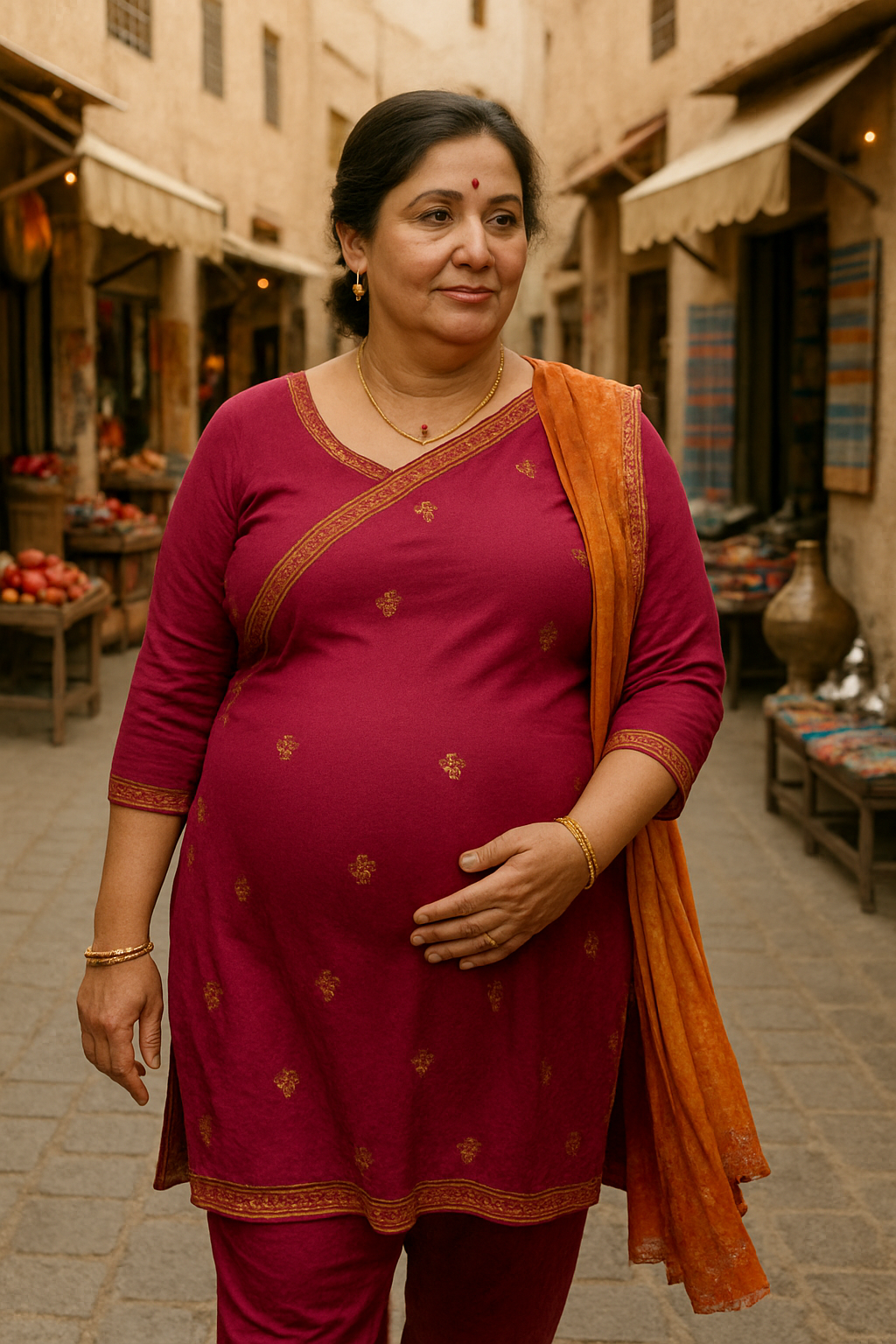
Her figure remained pear-shaped, hips broad and dominant, thighs strong, but there was a new heaviness to her curves—a soft, womanly fullness in her belly and arms. Her chest, already modestly ample, swelled further, heavy and maternal, pressing slightly against the fabric of her tunic.
Her gait slowed, not from fatigue but from a natural grace that came with confidence and experience. The quick curiosity of a traveler was gone, replaced by the measured pace of someone who knew every turn, every shop, every scent in these streets.
Then came the flashes.
A bolt of memory—sitting on a veranda in the monsoon season, sipping chai while rain painted the air silver—sent a flutter deep in her abdomen. Her belly swelled just a fraction, the beginnings of pregnancy settling naturally into her frame.
Another memory—kneeling in a small temple, pressing her hands together, the air thick with incense—brought another month of life growing inside her.
A memory of wedding garlands, bright with jasmine and marigold, her hand clasped in a man’s strong, warm grasp.
A memory of laughter in a small courtyard, her husband’s voice calling from his shop downstairs.
Month after month passed in seconds inside her mind, her belly swelling further until it rested heavily and proudly before her, the fullness of eight months’ pregnancy transforming her walk into a gentle sway. Her lower back arched slightly, her hand instinctively finding the curve of her womb as if it had been doing so for months as she was pregnant again with the third child.
Her language shifted completely now—English slipping away like a forgotten dream. The heavy accent she once had was gone; she now spoke solely in the fluid, musical cadence of her native tongue. The words felt natural, effortless, each syllable formed from a lifetime of use.
Gone was the thought of hotels and conference rooms. Gone was the image of boarding a flight back to America. This was her home, her land, her life. The thought of being anyone else was as foreign as the tourists she sometimes saw wandering her streets.
Her name was no longer Jake. It was Aditi Sharma, wife of the kind, weathered man who owned the little shop where she had first received the necklace.
She turned down a familiar alley and stepped into the shaded interior of the shop. Her husband looked up from the counter with a warm smile, his eyes crinkling in greeting. She leaned forward, pressing a gentle kiss to his cheek, murmuring something affectionate in their shared tongue.
Then, with a small smile, she made her way up the narrow wooden staircase at the back, her hand on the smooth railing. The upstairs was their home—a cozy, sunlit space filled with the smell of cumin and fresh bread, the sound of distant street vendors calling below.
Her tunic and trousers shimmered and shifted, becoming soft, form-fitting garments made for comfort, draping around her curves and accommodating the weight of her pregnancy. She sank into a cushioned seat by the window, resting one hand on her belly, the other playing absently with the glowing pendant at her chest.
Outside, life moved on. No one stared. No one questioned. To everyone, she was simply Aditi—wife, mother-to-be, and a lifelong resident of the city.
Jake had never existed here.
Years have passed since that warm afternoon in the marketplace—not that Aditi would ever think of it as the day anything “changed.” For her, it was simply another thread in the long, woven fabric of her life.
She lives in the same home above her husband’s shop, its walls painted in warm earth tones and decorated with photographs of family gatherings, festivals, and the growing line of children she and her husband have brought into the world. Their eldest is now in school, the younger ones still clinging to her sari as she moves about the house.
Every morning, she helps her husband prepare the shop before the city fully wakes, sweeping the floor, arranging goods in the display, and greeting early customers with a smile. The pendant still rests at her chest, now part of her daily attire, as unremarkable to her as the wedding bangles she never takes off.
Her days are full—cooking fragrant meals of dal, rice, and fresh vegetables; bargaining in the market for the week’s spices; laughing with neighboring women over cups of chai; and tucking her children in at night while telling them stories her own mother once told her.
She moves through life with the steady confidence of a woman deeply rooted in her community. Everyone in the neighborhood knows her name and her warm laugh. They know she can haggle like no one else in the bazaar, that she can soothe a crying child in moments, and that she keeps her household running with an efficiency that would humble even the busiest merchant.
There is no memory of boardrooms or flights to foreign countries. The idea of being anywhere else feels strange, like a dream she might have once heard in a story but quickly forgot.
To Aditi Sharma, this has always been her life. This city is her blood, her marriage her anchor, her children her joy.
And if the pendant at her chest still glows faintly now and then… she never notices.