Craig had always been the kind of man who saw the world not just for what it was—but for what it could be. Even as a kid, while others were playing tag or building Lego castles, Craig was taking apart clocks, radios, and whatever else his parents foolishly left unattended. Science wasn't just a subject for him—it was a language, a rhythm, a calling.
By the time he hit his mid-thirties, Craig’s curiosity had only grown wilder. He converted his modest suburban garage into a makeshift laboratory. The paint-stained walls were now hidden behind steel shelves stacked with wires, circuit boards, soldering irons, and half-finished prototypes. A bright orange extension cord coiled like a sleeping snake around the floor. At the center of it all stood Craig, wide-eyed and constantly scribbling in a grease-stained notebook.
His experiments, though driven by unshakable enthusiasm, rarely worked. His “gravity glove” made coffee mugs slightly colder instead of weightless. The “automated dog-walker” tripped over its own leash. Even his “solar-powered flashlight” was, upon later reflection, a contradiction in terms. But Craig didn't care. He learned from every failure—and then started again.
One rainy Thursday evening, as the wind ticked softly at the garage windows, Craig sat hunched over a new blueprint. His latest invention: a mind reader helmet.
“I call it… Project Synapse,” he whispered to no one in particular, eyes glinting behind his smudged glasses.
The idea had struck him after reading an old neuroscience paper. If brainwaves could be interpreted through EEG signals, then maybe—just maybe—he could build something that could decode them into words. It sounded impossible. And that only made it more tempting.
For the next several weeks, Craig barely slept. He soldered tiny electrodes into the helmet’s lining, programmed algorithms late into the night, and even added a small microphone for voice feedback, just in case the helmet could one day “speak” someone’s thoughts aloud.
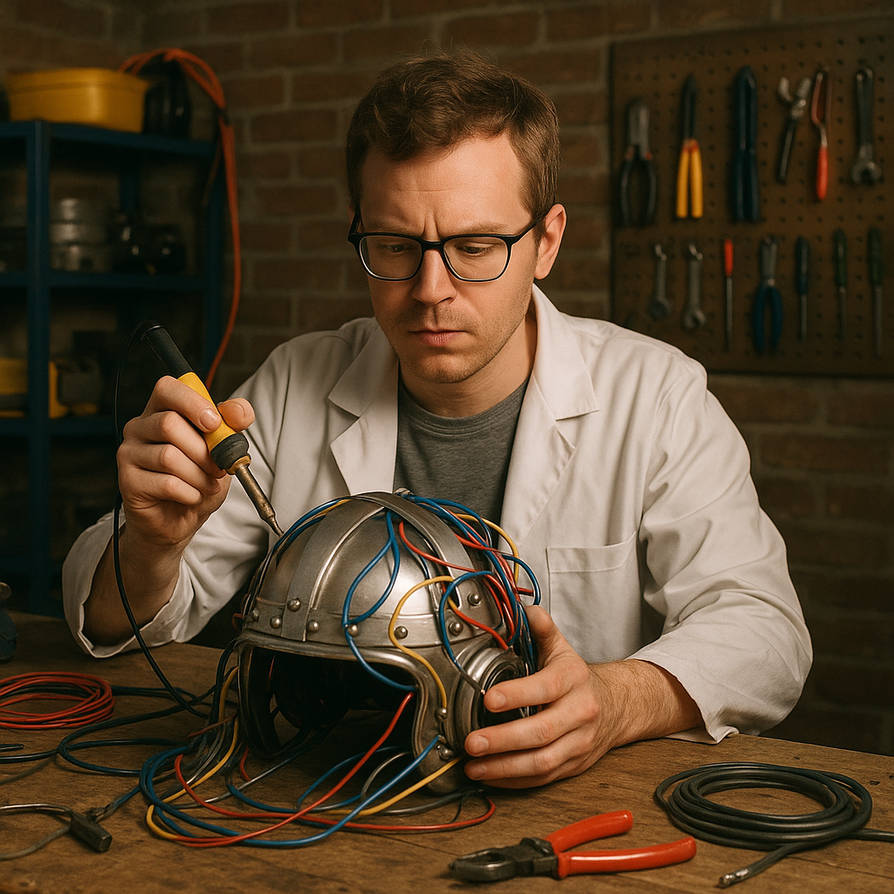
Finally, the device sat completed on his workbench: a bulky, chrome-domed helmet with wires spilling out like overcooked spaghetti. Craig looked at it, his heart pounding. He wiped his palms on his lab coat and smiled.
“Time to see what secrets the brain’s been keeping.”
He didn’t put it on just yet. Not tonight. But the machine sat there humming faintly—waiting.
Craig adjusted his glasses, the plastic frames slightly crooked from months of careless handling. He stared at the helmet—his latest, perhaps last, hope for a working invention. There was a nervous flutter in his chest, the kind that danced between anticipation and dread.
“Alright,” he muttered, “let’s see what you’ve got.”
He sat down, carefully placing the helmet over his head. The metal was cool against his scalp. Wires brushed against his ears as he reached for the control switch on the side of the helmet. With a flick, the device buzzed to life, lights blinking in rhythmic pulses.
He turned his head slowly toward the wall that separated his garage from the house next door.
Melody.
He didn’t know her well—just enough to exchange greetings over the hedge or hear the occasional pop song blaring from her open windows. Still, she was a likely test subject. He focused, letting the helmet do its thing.
And then he heard it.
Not with his ears, but in his head.
“Omg, should I go with the glitter gloss or matte?”
“Ugh, I love that new album—track five is literally my anthem right now.”
The voice was high, excited, and unmistakably feminine. Craig blinked in disbelief, his mouth slowly falling open. He was actually hearing someone’s thoughts—Melody’s thoughts.
“It… works,” he breathed.
But the celebration lasted all of ten seconds.
A sharp whine pierced the silence. Sparks shot from the helmet’s side as the metal began to vibrate. One of the circuit boards cracked, sending a piece clattering to the floor. Then another. The lights blinked erratically.
“No no no—” Craig reached to remove it, but before he could lift the helmet, a blinding flash filled the garage.
BOOM.
The blast sent him flying backward, crashing into the drywall with a sickening thud. Everything went black.
Three hours later, Craig opened his eyes.
His head throbbed, and the air stank of burnt plastic and ozone. He groaned as he sat up, brushing off flakes of plaster from his coat. His lab was a wreck—scorched wires, shattered components, and in the center of it all, the smoldering remains of the helmet.
Craig stared at it in stunned silence.
Then anger took over.
He stomped toward the workbench and began smashing what was left. Sparks flew as he crushed the cracked visor underfoot. He ripped wires apart with trembling hands, his frustration bubbling over in furious growls. It wasn’t just another failure—it was a mockery of everything he’d poured into it.
When he was done, the helmet was nothing more than scattered fragments. He paused, panting, eyes falling on a small object glinting amid the mess.
The gem.
Roughly the size of a walnut, faceted like a crystal, and glowing faintly with a pulsing inner light. Craig had bought it from a sketchy forum buried deep in the web. The listing had been vague—"Power source, experimental, no refunds"—but he’d wired it into the helmet’s power core, desperate to give the invention a unique spark.
He picked it up, its warmth unexpected in his hand, and set it down gently on his desk. The glow flickered, almost as if in rhythm with his heartbeat.
Craig turned away and trudged to his bedroom upstairs. He didn’t care about science tonight. He didn’t care about inventions or breakthroughs. He just wanted to sleep.
And as he slipped under the covers, the gem on the desk pulsed once… just a little brighter.
The days that followed the helmet’s explosion passed quietly—at least on the surface. Craig told himself he was just taking a break from inventing, recharging his mind. He didn't suspect, even for a moment, that something else was slowly rewiring him.
It began subtly.
One morning, Craig found himself flipping through channels, looking for something to distract him. Without thinking, he stopped on a teen drama—Starlight Diaries, a show about high school friendships, makeovers, and a love triangle between a pop star, a skater boy, and a bookish tutor.
He watched it for hours.
“I mean… the writing’s just surprisingly good,” he muttered to himself, defensively, even though no one had questioned him.
The next day, he found himself humming one of the show’s theme songs. Catchy. A little too catchy. He looked up the artist on his phone and added the whole album to his playlist. From there, the descent was seamless—bubbly pop music, pastel visuals, and YouTube makeup tutorials filled his browser history.
He didn’t even blink when he bought a bright strawberry-scented body wash during a grocery run.
Meanwhile, his habits began to shift.
Where Craig used to roll out of bed and shuffle straight into his lab coat, now he spent time in front of the mirror. At first, it was just brushing his hair. Then came tweezing stray brows. Then he began trying different facial cleansers, comparing skin textures.
He didn’t notice that his hair had begun to soften at the ends, falling with a slight curl that hadn’t been there before. Or that his jawline looked just a little less sharp when he shaved.
He was completely oblivious to the subtle reshaping of his body—his face smoothing slightly, eyelashes darkening and thickening by degrees. His hands, once rough from years of soldering and handling metal, were softening, fingers growing more slender. Even his voice, while still recognizably his own, had taken on a softer cadence, especially when he got excited talking about his favorite character from Starlight Diaries.
Science began to bore him.
Not all at once, but it started with small things. He left a half-built circuit board untouched for days. The blueprint for a voice-controlled drone lay buried under fashion magazines he didn’t remember subscribing to. When he thought about his lab, the thought didn’t bring excitement anymore. It brought a sort of dull ache, like remembering an old hobby that no longer sparked joy.
He didn't question any of it.
If anything, he felt more himself than he had in a while—though he couldn't articulate why.
In his bedroom, the strange gem still sat on his desk. Quiet. Innocent. Its glow dimmed to almost nothing… waiting.
The days passed like soft static—strangely quiet, yet buzzing with unspoken change.
Craig had fallen deep into his new routine. His TV rarely left the realm of teenage dramas and sitcoms now. Disney Channel reruns, melodramatic love stories on The CW, nostalgic ABC Family lineups, and glossy Netflix originals filled his evenings. He wasn’t just watching them—he lived them. He debated love triangles out loud, related to the awkward teen protagonists, and even teared up during a particularly emotional season finale.
His phone, once used mainly for research and ordering parts, was now an extension of his hand. He scrolled through Instagram for hours, following beauty influencers, fan pages for fictional couples, and viral dance trends. TikTok’s algorithm quickly learned what to feed him: makeup hauls, outfit ideas, “day in my life” vlogs of teenage girls with pastel aesthetics and neatly organized planners. It felt comforting, even though he never stopped to question why.
His search history had changed.
Gone were the keywords like “flux capacitor design” and “how to stabilize energy output.” In their place: “soft glam tutorial,” “best tinted lip balm,” and “how to layer bracelets.” He even joined a few online forums meant for teenage girls, chiming in with oddly specific opinions on moisturizer brands and favorite character arcs.
Yet Craig remained completely unaware.
Physically, the changes deepened.
His facial features had softened further—cheekbones subtly higher, lips fuller without any cosmetic help. A gentle flush of color seemed permanently present on his cheeks, like the faintest touch of blush. His body had begun to narrow in the waist, and though he hadn’t noticed, his hips had taken on a faint curve that gently altered how his clothes fit. T-shirts clung in strange new places. Jeans once loose at the hips now hugged tighter.
His posture shifted without thought. He crossed his legs more often, twirled his hair absentmindedly when lost in thought, and held his phone at angles that echoed teenage selfies rather than scientific documentation.
But most telling of all were the changes happening around him.
His home, once utilitarian and cluttered with wires, quietly morphed.
The lighting in the bathroom seemed warmer, more flattering. His old scratchy towels had somehow been replaced with soft, pastel pink ones with floral embroidery. His desk, once crowded with blueprints and tools, now held a growing collection of neatly arranged skincare products and a pink spiral notebook covered in stickers.
In the kitchen, mugs with sarcastic science quotes had been quietly replaced with ones saying things like “But First, Coffee” in swirling gold letters. Even the fridge bore a collection of cute magnets and a handwritten reminder: “Mel’s Birthday Party – Don’t forget!”
He didn’t remember writing that.
He didn’t even know if he was invited.
Yet none of it raised a flag. Every change slipped past him like a dream you forget the moment you wake up. He smiled more. He giggled at memes. And when he caught his reflection, he thought he looked—well—refreshed.
Science had long since faded into the background of his life.
And still, the gem sat quiet on the desk, pulsing faintly under the soft glow of his fairy lights.
It didn’t happen all at once—but when it was over, not a single trace of Craig remained.
In the final days of the transformation, reality bent quietly but completely, shaped by the glowing pulse of the gem that still sat silently on the desk, now repurposed into a vanity table covered in lip gloss tubes and perfume bottles. The gem didn’t glow brighter—it simply did. It existed with intention, rewriting the world around it with casual precision.
Craig’s body—once angular and worn by time—shifted smoothly, day by day, into something younger, softer, and undeniably feminine. The last of his stubble never grew back. His shoulders narrowed; his torso slimmed, forming a subtle hourglass that grew more pronounced each morning. His chest swelled gently, then fully, until there was no mistaking the outline of a girl who had just stepped into adolescence with confidence and curves she hadn’t earned through time but through rewritten biology.
Her face now held the glow of youth: wide eyes with long lashes, a perky nose, and lips that pouted naturally, even when she wasn’t trying. Her voice had climbed in pitch, full of vocal fry and a constant undertone of casual complaint, often stretched into exasperated sighs.
She stood in front of the mirror each morning, now completely comfortable in her skin-tight jeans, crop tops, layered necklaces, and platform sneakers. Hair—long, glossy, and caramel-brown—was curled daily with the precision only someone with hours of TikTok tutorials could master. She didn’t know how she knew all of this. It just felt like something she had always known.
Because as far as she remembered, this was her life.
Her name was no longer Craig. It was Brielle.
Brielle Madison Whitmore. Sixteen, totally cute, super into herself, and living a charmed, if dramatically imperfect, teenage life. She wasn’t a scientist. She barely passed algebra. She didn’t care about science—ugh, boring. She cared about popularity, her phone, getting the newest beauty drops, and keeping her Snap streaks alive. Her old interests and knowledge had dissolved, replaced with teenage instincts, hormonal chaos, and a worldview that revolved entirely around her social life and what outfit to wear to the mall.
The house had changed, too.
Craig’s old suburban lab-turned-garage had been erased, overwritten like a corrupted file. In its place sat a pristine, modern mansion tucked inside a gated community. Every inch screamed wealth: marble countertops, a winding staircase, and a backyard with a private pool. Brielle's bedroom was a bubblegum paradise—pink walls, white vanity lights, posters of pop stars, shelves full of high-end handbags and designer shoes. A fluffy white dog named Cupcake slept at the foot of her bed.
She lived with her picture-perfect family of six:
Her dad, Richard Whitmore, a handsome CEO who adored his "princess" and never said no.
Her mother, Jasmine, graceful and glowing, heavily pregnant and pampered.
Her older sister, Vanessa, in college and just a little too cool.
Her younger sister, Chloe, the sporty middle child always rolling her eyes.
And the baby, still months away from being born.
Everything in Brielle’s world made sense—to her. She remembered birthday parties, cheer practice, fights with Chloe over clothes, TikToks she swore went viral, and dozens of little memories that felt as real as breath.
She didn’t remember Craig.
She didn’t remember the lab, the experiments, or the accident. To her, science wasn’t something she forgot—it was something she’d never once cared about. She remembered crying over boys, not circuitry. She remembered her first iPhone, not her first prototype.
The gem remained, tucked into a pink crystal jewelry box on her desk, still glowing faintly, still quietly humming in a frequency just below reality.
And Brielle?
She twirled her hair in the mirror, snapped a selfie, and groaned at her phone.
“Ugh, Chloe literally took my contour stick again. I’m like, so done with this family right now.”
And with a huff, she flopped back on her plush bed, kicked off her heels, and turned up her playlist—completely unaware that anything had ever been different.
Brielle’s life was, in a word, perfect—at least, that’s how she saw it.
Each morning began with the sunlight filtering through soft-pink curtains and the scent of vanilla body mist clinging to the air. Her room was a plush teenage dream: pastel throw pillows, shelves stacked with hair products and influencer makeup palettes, and a walk-in closet that held more outfits than she could ever wear in a single school year.
Downstairs, her family life was just as curated.
Her dad, Richard Whitmore, never questioned her excessive spending, constant attitude, or the swarm of delivery boxes labeled with names like Glossier, Revolve, and Sephora. To him, she was his “princess,” and what she wanted, she got. His credit card practically lived in her phone. If she wanted a new phone case? Done. A spontaneous trip to L.A. with Miranda? He’d call the car service.
Her mom, Jasmine, was too wrapped up in her latest pregnancy to discipline anyone. She spent her days lounging in designer maternity wear, surrounded by candles and prenatal smoothies, while occasionally reminding Brielle to “try not to be too hard on your sisters, sweetie.”
Her older sister, Vanessa, barely acknowledged her, too busy being a perfect college student and rolling her eyes every time Brielle talked about her "follower count." Brielle thought Vanessa was just jealous, honestly.
Chloe, the middle sister, was the only one who really challenged her—tomboyish, practical, and so annoying. Brielle constantly accused her of stealing clothes, even though Chloe clearly had no interest in pink lace crop tops. Their daily shouting matches were practically a household tradition.
And the baby? Still on the way. Brielle had already declared she was naming it if it was a girl. (She hadn’t told anyone the name yet—she was saving it for a dramatic reveal.)
At school, Brielle reigned like a queen in a rhinestone tiara—metaphorical most days, but very real on spirit days.
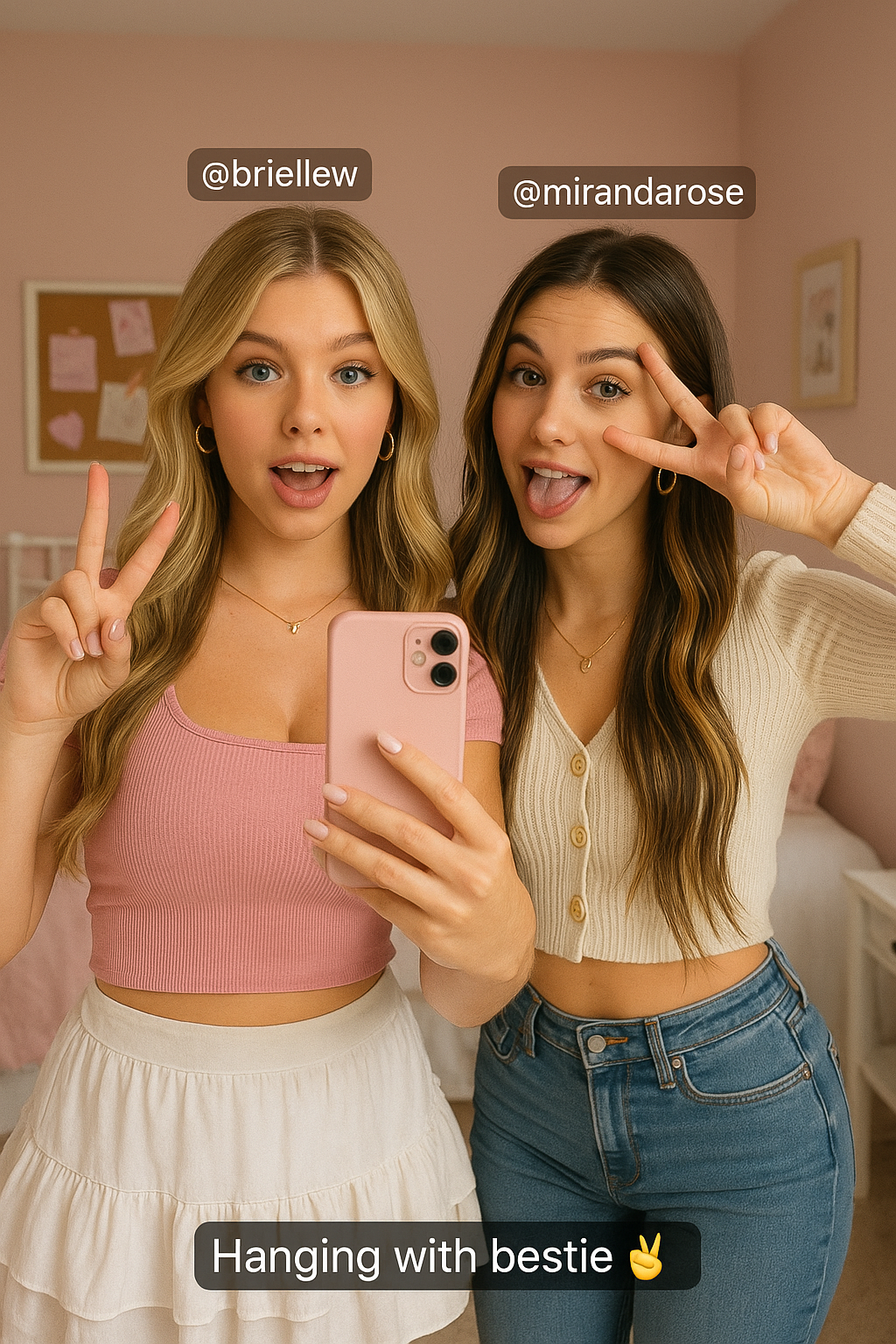
She and her best friend Miranda were the undisputed alphas of South View High. Cheerleaders, trendsetters, social media darlings, and the kind of girls who got free drinks at smoothie shops just for showing up. They walked through the halls in tandem, high ponytails swinging, their designer backpacks bouncing in sync.
Their conversations were always loud, always shallow, and always about themselves:
“Oh my God, can you believe Taylor’s shoes today? Like, did she find them in a donation bin?”
“I literally almost cried when my lash extension appointment got pushed. Like, do they not know who I am?”
They weren’t cruel exactly—they were worse: dismissive. Unless you were in their inner circle or useful to them, you were invisible.
They owned the school. Teachers barely challenged them, students either admired them or avoided them, and every homecoming nomination had their names stamped on it in glittery Sharpie. Miranda and Brielle had their own table at lunch, their own private group chat (titled “💖ME & QUEEN M💖”), and their own rivalry with every other girl who even thought about stealing attention.
Brielle’s phone was her life: Instagram polls about what earrings to wear, videos of herself lip-syncing and posing with Miranda, and carefully posed selfies with filters that sparkled just enough to seem casual. Her captions? “✨Mood✨” or “If you’re not obsessed with me, you’re doing it wrong.”
Every now and then, she’d feel a weird little flutter in the back of her mind—a kind of static, like remembering something that wasn’t hers. A glimpse of a tool bench, the smell of soldering metal, a man's voice mumbling formulas. But it always disappeared in a blink, swallowed by whatever new drama she was immersed in. A party, a text, a new song, a boy with abs—obviously more important.
She never suspected the truth.
She didn’t know that all those days ago, in the garage of a life that no longer existed, the helmet hadn’t scanned her intended neighbor Melody—but her teenage sister, Miranda.
The thoughts Craig had heard—that bubbling cocktail of vanity, gossip, glitter, and ego—hadn’t been from a grown woman at all, but a 16-year-old high school queen bee.
And now, that exact personality—the sass, the entitlement, the bratty sparkle—was her.
Brielle Madison Whitmore had never heard the name Craig. She couldn’t tell you what a capacitor was. Her idea of an “experiment” was mixing bronzer with liquid highlighter.
And as far as she was concerned, she was always meant to be this way.