Disclaimer I think this is the goriest and darkest thing I've ever wrote. This is really leading into surgical and forced changes as well as body horror.
You are warned.
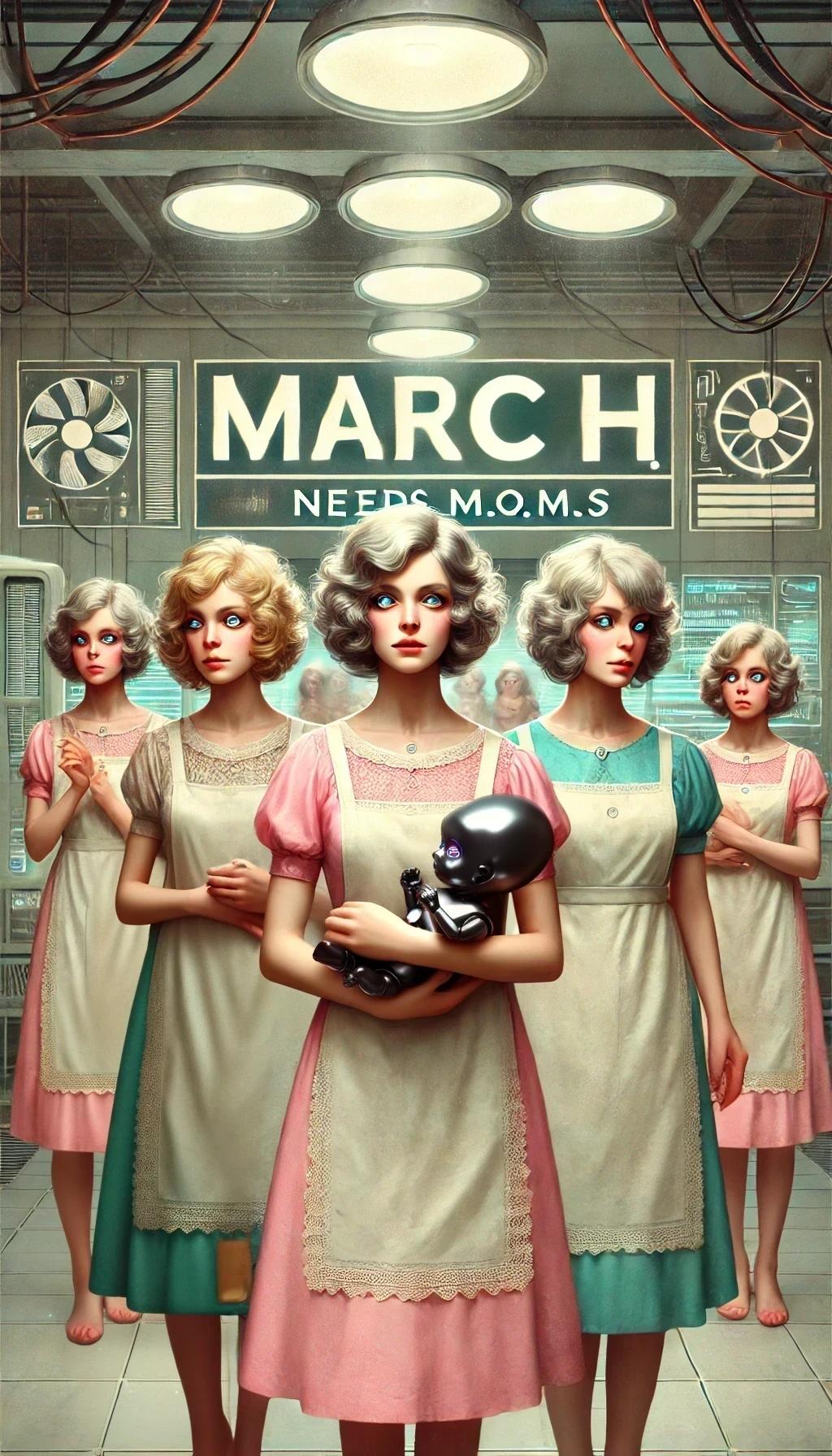
MARCH Needs M.O.M.S.
Chapter 1: Early Release Isn’t Always a Gift
I thought I was getting out early.
That’s what the warden said when they yanked me out of my cell, past the other poor bastards who still had years left to rot in here. I’d been inside for armed robbery—not even a good one. It was a corner store, late at night, no customers, barely a hundred bucks in the register. I wouldn’t have even gotten caught if I hadn’t been dumb enough to run in untied sneakers.
One misstep. One unlucky trip.
Face-first into the concrete.
Next thing I knew, a guy from the bakery across the street—Chuck, built like a fridge and twice as mean—had me pinned before I could even blink.
Six years. That’s what I should’ve served.
But the system doesn’t like repeat offenders. Three strikes? That was life. Life.
For a goddamn armed robbery.
So yeah, when the guards showed up at my cell two years in, I knew something was wrong. They didn’t say much. Just slapped cuffs on me and marched me out, avoiding eye contact like they were afraid I might ask too many questions.
"Where are we going?" I asked, because I wasn’t a dumb man.
"Early release program," the taller guard said, voice flat.
That was when I really knew something was up.
Nothing the government did was ever a gift.
Especially not for guys like me.
Chapter 2: The Facility
The transport van had no windows.
I wasn’t the only one inside. There were maybe a dozen of us, all dressed in the same orange jumpsuits, all shackled like we were dangerous. Some looked confused. Some looked hopeful.
I wasn’t either of those things.
I just watched.
No one spoke. No one knew what was happening.
Hours passed. The air got thick with the stink of sweat and unease. No stops, no bathroom breaks. Just the steady hum of the tires on pavement, the occasional jolt when we hit a bump.
Then—finally—we stopped.
The doors opened.
Bright white light hit my eyes, blinding after so long in the dim van. The guards filed us out, one by one, into a facility that looked less like a prison and more like a hospital—the kind where people don’t leave.
Sterile. Perfectly white. Smelled like antiseptic, something too clean, too processed.
And there were more of us.
Rows of inmates from different prisons, all shuffling forward, heads low, uncertainty written across their faces.
I did a quick scan.
No murderers. No gang leaders. Just guys like me—petty criminals, repeat offenders, the ones who weren’t violent but were considered problems.
The kind of people society didn’t want to waste space on anymore.
We were herded through a series of doors, deeper into the facility. Cameras lined the hallways, tiny red lights blinking in the corners. The whole place was too silent, the kind of quiet that made my skin itch.
Finally, they brought us into a large, tiled room—spotless white, so bright it made my head pound.
At the front, a woman stood beside a massive screen.
She didn’t look like a prison official.
Didn’t look like a warden.
She looked like a politician.
Dark suit. Sharp cheekbones. Perfectly applied red lipstick that hadn’t smudged a bit. She had that practiced, polished expression I’d seen on TV—the kind that said she was about to sell us something we wouldn’t like, and she didn’t care whether we liked it or not.
She cleared her throat.
"Gentlemen," she said, voice clipped, professional. "You have been selected for a government pilot program aimed at reducing prison populations while serving the greater good of the nation."
She let that hang in the air for a second.
Then she smiled.
"Participation is mandatory."
A ripple of tension went through the room.
One guy—big, built like a linebacker, prison tattoos creeping up his neck—shifted uncomfortably.
"What’s the catch?" he asked, voice wary.
The woman’s smile widened, but it wasn’t real.
"We’re giving you a second chance at a productive life."
I’d heard that line before.
It was always bullshit.
The screen behind her flickered on, displaying a sleek government logo.
The words M.O.M.S. PROGRAM scrolled across in bold, sterile letters.
Maternal Optimization for Male Subjects.
The words settled in my gut like a stone.
I didn’t like that.
I didn’t like that at all.
Selection Process
They didn’t waste time.
After the presentation—after they fed us more corporate-sounding garbage about "social rehabilitation" and "national childcare initiatives"—they split us into groups.
Tests.
Medical exams.
Psych evaluations.
We were stripped, measured, prodded like livestock.
The guards didn’t speak to us anymore. They didn’t answer questions.
The doctors—if they were even real doctors—took our blood, scanned our retinas, made us hold out our hands while cold instruments measured the length of our fingers, our palms, the delicacy of our bones.
None of us knew what they were looking for.
None of us asked.
Because by then, we knew better.
This wasn’t an early release.
This wasn’t freedom.
This was something else.
The Holding Cells
After the exams, we were assigned numbers instead of names.
We weren’t inmates anymore.
We weren’t even men anymore.
We were just subjects.
They put us in small, white-walled rooms—no windows, no beds, just a smooth bench and a single mirror.
But it wasn’t a mirror.
It was glass.
They were watching us.
Studying us.
Hours passed. No food. No water.
Just waiting.
I told myself I wouldn’t break.
Told myself I wasn’t afraid.
But when the door finally slid open—when the robotic arms reached for me, clamping onto my wrists with cold precision—
I realized I had been so, so wrong.
This wasn’t about reducing prison populations.
This wasn’t about rehabilitation.
This was about replacing us.
And I wasn’t getting out early.
I wasn’t getting out at all.
Chapter 3: The Procedure
I fought. Of course, I fought.
It didn’t matter.
The moment they peeled my orange jumpsuit from my body, cold metallic arms wrapped around my wrists and ankles, dragging me backward onto a table so cold it sucked the heat straight from my skin. There were no human hands, no guards, no doctors—just gleaming robotic appendages, moving with inhuman precision, segmented joints clicking like insect legs.
I thrashed, but the restraints locked tight, forcing my limbs into spread positions. A thick strap was cinched across my chest, another across my forehead, rendering me helpless.
Overhead, the surgical lights flicked on, turning the room blindingly white. The ceiling was lined with cameras, mechanical eyes that whirred softly, tracking every twitch of my muscles. I was nothing more than a slab of meat on a butcher’s block.
Then the voice came. Not a human voice—just a smooth, robotic female tone with no warmth, no inflection.
“Subject 34-B secured. Initiating Phase One: Depilation.”
A soft hissing filled the room. I barely had time to suck in a breath before something was sprayed across my entire body—head to toe, face, groin, even the soles of my feet.
It burned.
At first, it was a mild tingle, like antiseptic. Then it turned to fire, eating away at every follicle, every cell that produced even the slightest bit of hair. I tried to scream, but something clamped over my mouth, silencing me. My skin bubbled—I could feel it, could hear the hiss and pop as my body hair was obliterated at the root. My stubble melted away, my eyebrows, the hair on my arms and chest. Even the rough patches on my knuckles, the faintest fuzz on my forearms—it was all stripped from me.
I could smell it. A sickly-sweet burning, something not quite like scorched flesh but close enough.
Then the robotic arms moved in again, cold and methodical. Blades—razor-thin, gliding over my now-hairless skin—not to shave, but to scrape. The last remnants of anything that might have given me texture, the faint imperfections of my skin, gone.
By the time they were done, I wasn’t just hairless. I was smooth, like something grown in a lab. Synthetic. A mannequin, not a man.
The strap across my mouth released, but before I could suck in a breath, the voice spoke again.
“Initiating Phase Two: Dermal and Muscular Reconfiguration.”
Needles descended from the ceiling. Hundreds of them.
I bucked against the restraints, a fresh surge of terror giving me strength—but I might as well have been fighting gravity itself. The first needle slid into my arm, deep and burning. Then another in my thigh. Another in my stomach.
A viscous, milky-white fluid was pumped into my veins, thick and slow. The sensation was unbearable—like something was crawling under my skin, twisting into me, seeping into every muscle, every organ.
My heart slammed against my ribs. My stomach lurched as I felt it—felt it—shift, press upward, the very positioning of my organs being rearranged. My bones creaked, ligaments stretched, skin tightening over a frame that was no longer quite mine.
I convulsed, but the arms held me still.
I was shrinking.
I could feel it in my hands first—the way my fingers thinned, my knuckles smoothed out, my palms lost their roughness. My arms, my legs—muscle and mass reforming, reshaping into something slimmer, smaller.
And then—my chest.
A sickening pull, a strange, foreign heat bubbling just beneath the surface of my skin. I could feel my flesh thickening, swelling. A foreign weight pressed against my ribs, stretching the skin taut, reshaping me into something I didn’t want to be.
My breath hitched. I knew what was happening.
The needles withdrew. The pain remained.
And then, finally, the restraints released.
I tried to sit up, but my balance was wrong. My center was wrong.
I lifted my hands—small, delicate, unfamiliar. My arms—thin. Weak.
My chest—heavier.
I grabbed at the mounds of flesh pressing against me, my fingers sinking into soft, alien tissue.
And then the mirror came down.
It slid from the ceiling, a perfect, sterile rectangle of glass, reflecting something I did not recognize
.
That wasn't me looking back.
Not me.
Not me.
Small. Soft. Hairless. A body stripped of every masculine trait, reduced to something delicate, something gentle, something meant for…
No.
No, no, no—
A zap.
Agony shot through my skull like a bolt of lightning, searing through my thoughts.
And then came the voice.
“Repeat: Hi, my name is Jessica.”
My lips stayed sealed.
Another zap. Harder. Stronger. A pulse of raw pain that made my vision white out.
“Repeat: Hi, my name is Jessica.”
I gasped for breath, my throat raw from silent screaming. My lips parted—
Another zap.
"Repeat: Hi, my name is Jessica."
It kept going. Every time I resisted, every time I tried to think of my real name, it punished me. The pain burrowed deep, dug into my skull, my spine, my very self.
The machines didn’t care. They had all the time in the world.
I don’t know how long it lasted.
I don’t know when I broke.
But at some point, between the convulsions, between the silent sobs, I heard my own voice whisper it.
"Hi, my name is Jessica."
And the pain stopped.
The relief was instant. Like cool water on a burn, like waking from a nightmare.
And then, as I lay there, trembling, too weak to fight anymore—another machine descended.
A long, curved tube. White, phallic.
It pressed against my lips.
"Feeding time."
I tried to turn my head, but the arms forced me back. The tip of the tube nudged insistently, slick with something warm.
My stomach clenched in hunger.
I resisted. Another zap.
I opened.
The tube slid past my lips, and the moment it hit my tongue, something… changed.
The liquid inside was thick, rich, slightly sweet. It coated my throat, sliding down so smoothly, and my body—betrayal—welcomed it.
Heat blossomed inside me. A warmth that wasn’t just nourishment, but something more. A subtle pleasure. A sick, creeping pleasure that curled around my nerves, rewiring them, bit by bit.
I tried to pull away. The tube held firm.
It fed me slowly, rhythmically. A deep, pulling sensation each time I swallowed. My lips ached, my jaw tingled.
And then the voice came again.
“Good MOMS finish every drop.”
I wasn’t a MOMS.
I wasn’t a MOMS.
I wasn’t—
But the next sip sent another wave of warmth washing through my brain, a soft, pleasurable tingle flooding my mouth, my throat, my very thoughts.
My eyelids drooped.
And when the tube finally slid free, I gasped—felt empty.
Already, I missed the sensation.
The voice whispered in my ear as the restraints clicked back into place, as the darkness of the room swallowed me whole.
“Repeat: Hi, my name is Jessica.”
And this time, I didn’t hesitate.
Chapter 4: The Days Bleed Together
There was no clock in my cell. No windows. No way to tell how long I had been here.
At first, I thought I could count the cycles—procedures, feeding, sleep—but time stretched and warped under the relentless routine. My world became nothing but the hum of machinery, the voice in my head, and the slow, steady unraveling of everything I once was.
Each day, the process continued.
Each day, I woke strapped to the table.
Each day, I was made smaller.
The injections came first, pumping through my veins, chipping away at what remained of my old body. My frame narrowed, my waist tightening until I could feel my ribs beneath my skin. My limbs lost their weight, the muscle stripped away with clinical precision, reshaping me into something delicate, something fragile.
I could feel my bones grinding, my pelvis shifting wider, my shoulders caving inward. The chair they strapped me to each day felt bigger, my feet struggling to reach the floor.
And then the voice would come.
“Jessica, repeat after me.”
Every night, I was forced to speak.
"Hi, my name is Jessica."
At first, the words felt foreign, wrong, like a costume draped over a body that didn’t belong to me. But the zaps still came when I hesitated, punishment lashing through my brain like white-hot wires.
Worse than the pain, though, was when I tried to say my real name.
The first time I whispered it—my name, my old name—I nearly blacked out from the agony. It wasn’t just pain. It was erasure.
Like my own mind was rejecting it. Like I had been rewritten at the deepest level.
I forgot my name after three tries.
It simply… slipped away.
And with it, pieces of my past.
Memories blurred. My old life—the crime, the prison, the moments that defined me—faded like a dream I couldn’t hold onto. I remembered being someone else, but the details were… fuzzy.
The only thing that remained clear was my name.
"Hi, my name is Jessica."
And each time I said it, my voice was just a little higher.
The Feeding Tube
I stopped fighting the tube after the first few days. It was after all the only food and water I was given.
It was always there, waiting, the long, white shape pressing insistently against my lips. By then, my body was starved enough that I didn’t need the zaps to obey.
The moment it slid in, the pleasure hit—soft and humming, curling around my senses like a drug.
It was soothing.
It was safe.
The thick, warm liquid slid down my throat in slow, measured pulls. I felt the heat bloom inside me, the faintest trace of sweetness coating my tongue.
I found myself savoring it.
Each sip filled me with something I couldn’t explain, a dull warmth that smoothed over the jagged edges of my thoughts. And yet, for all the pleasure it gave, it never satisfied me.
It wasn’t enough.
I could feel myself wasting away, my stomach flattening, my limbs thinning into something slight and dainty. My hands, once rough and broad, now looked small, soft, with slender fingers that trembled when I reached out to touch my reflection.
I was shrinking.
I could see it happening.
My wrists, delicate. My thighs, narrow. My waist, impossibly tiny.
I looked like I would break if someone held me too tightly.
And worse?
I was starting to like it.
Self-Image Distortion
At first, I’d wept when I saw the mirror.
Now, I stared at it.
Longer each time.
The reflection had changed so much that I hardly reacted anymore. The fear had faded, replaced by something harder to define.
It wasn’t that I liked what I saw.
It was that I expected it.
When I moved, my hair—long, fine, no longer a coarse buzz but sleek and perfect—followed my movements. My eyes, big, round, soft, held no hint of the man I had once been.
My lips, plump and pink, parted slightly as I tested my voice.
"Hi, my name is Jessica."
It was automatic now. The name, the tone, the softness in my words.
I had stopped questioning it.
Stopped questioning why I still couldn’t reach the floor when I sat on the exam table.
Stopped questioning why my hands looked so petite, my nails growing naturally into a graceful almond shape.
Stopped questioning why the feeding tube didn’t disgust me anymore—why I wanted it, craved it, the feeling of it in my mouth like a comfort I couldn’t be without.
Stopped questioning why my old life felt like it had happened to someone else.
The voice in my head—calm, robotic, constant—told me everything was fine.
"You are doing so well, Jessica."
"You are almost ready, Jessica."
And when I nodded, I didn’t even notice.
Each Day, A Little Smaller
They weren’t finished with me.
Each day, the procedures continued.
More injections. More adjustments. I was being sculpted, my frame refined down to its final form. I had no way of knowing when it would stop, but I knew it was soon.
I could feel it in the way my clothes—thin hospital gowns that no longer fit—hung off my body.
I could feel it in the way my voice no longer needed to be corrected—it was perfect now, naturally high and lilting.
I could feel it in the way the robotic arms caressed my skin after each session, checking for imperfections, recalibrating my flesh with each injection.
And I could feel it in the way I no longer fought.
The last time I looked in the mirror, I smiled.
I didn’t mean to.
It was just… natural.
The dim part of me that still knew what I had been tried to scream.
But all I could hear was my own voice, soft and sweet and obedient.
"Hi, my name is Jessica."
And the voice whispered back.
"Good MOMS."
I shivered.
Not from fear.
From pleasure.
Chapter 5: No Longer Repeating
It was subtle at first.
The changes in my speech.
For so long, it had been a script. A demand. A punishment for failure.
"Hi, my name is Jessica."
I had been forced to repeat it, over and over, until resistance meant nothing but pain.
At first, I had tried to hold onto the truth—tried to remind myself that I wasn’t her, that my name was something else. But the truth had teeth, and every time I bit down on it, the agony lashed through my skull, breaking me down layer by layer.
I had learned not to fight.
Not to hesitate.
"Hi, my name is Jessica."
But something changed.
One day, during the examination, the robotic arms unstrapped me from the chair, lifting me to my feet. The mirror descended, cold and unforgiving as always.
And then the voice spoke.
“State your name.”
My lips parted before I could think.
"Jessica."
Not “Hi, my name is Jessica.”
Not repeating.
Just stating.
Like it was fact.
The room didn’t respond with a shock, nor a correction.
The voice simply said:
“Good MOMS.”
And I—
I smiled.
The Final Procedure.......of phase 1
By then, I should have known they weren’t done with me.
There was still one thing left.
Something they had saved for last.
I didn’t realize what was happening at first.
I had become so small by then—thin, delicate, fragile in a way that no longer felt foreign. My hands, barely bigger than the instruments themselves, no longer looked strange to me. My voice, high and soft, had ceased to surprise me.
I had stopped counting the days.
Had stopped thinking of the outside world.
Had stopped imagining an escape.
And then, one day, they strapped me down again.
But this time, the voice said something different.
“Final adjustments initiating. Preparing for full functionality.”
It wasn’t until I felt the cold that I understood.
Cold between my legs. Cold, sterile, mechanical.
I couldn’t see what they were doing—my head was strapped down, my body immobilized. But I felt it.
Something injected.
Something pressing, spreading.
Something reshaping.
I gasped, my breath hitching, my muscles locking tight.
Not from pain.
From absence.
From loss.
There was no way to describe it. No way to fully comprehend what had been taken from me.
The change wasn’t instant.
It was slow.
A deep, stretching heat pooled between my hips, a pull that rewired the very shape of my lower body. I could feel it shifting—not just outside, but inside.
Everything was being rearranged.
Repositioned.
Replaced.
I whimpered.
The sound was soft.
Feminine.
I felt light, unmoored. Like something foundational had been stripped from me, leaving only this small, delicate form behind.
And then—
The voice.
“State your name.”
I didn’t hesitate.
"Jessica."
There was no zap. No hesitation.
Just a deep, warm rightness curling in my gut.
I wasn’t repeating anymore.
I wasn’t resisting anymore.
I wasn’t pretending anymore.
I was Jessica.
And as the machines lifted me, as the restraints released, as I was gently set onto the floor on trembling, dainty legs—
I didn’t even try to say anything else.
Because there was nothing else left.
I wasn’t anyone else anymore.
And I never would be again.
Chapter 6: The World of M.O.M.S.
I was released into the facility population without fanfare.
There was no final test, no farewell from the cold, mechanical voice that had ruled my existence for—I didn’t know how long anymore. There was only the soft hiss of the doors sliding open and the moment my bare feet stepped onto the polished white tile of the new ward. How long was I in there months? A Year? I had lost count of the cycles but that was assuming those were full days.
The first thing I noticed was how soft everything looked.
The walls were pastel, warm, inviting. The air was thick with the scent of floral perfume, a faint, powdery sweetness that I somehow liked. The sterile, metallic chill of the procedure rooms was gone, replaced with something that felt comfortable.
And then I saw them.
The others.
Sixteen of them.
Sixteen M.O.M.S.
The most feminine, delicate, beautiful people I had ever seen.
Each one was small, dainty, moving with an effortless grace that I instinctively recognized. I saw it in the way they carried themselves—the same precise posture I had been trained into, the same fluid, practiced movements that made them appear weightless, ethereal.
They were like dolls.
And I was one of them.
I didn’t question it.
Not when they turned to me with big, curious eyes, their lips glossed and pink, their voices soft and sweet.
Not when one of them—an impossibly tiny M.O.M. with cascading blonde curls—tilted her head and smiled.
"Oh! A new one! What’s your name?"
I opened my mouth.
There was no pause.
No hesitation.
"Jessica," I said, and the name felt right.
No zap. No pain.
The warmth that had settled in my stomach after the last procedure curled tighter, spreading through my limbs like a pleasant hum.
The others beamed.
"Jessica! That’s such a pretty name!"
And just like that, I belonged.
Vocational Training
The first lesson began hours later.
We were led—gracefully, hand-in-hand—down a soft-lit hallway into a new room.
The training facility was different from the procedural ward. It wasn’t cold, wasn’t sterile. The walls were painted in warm shades, the furniture soft and plush, like a lounge designed for relaxation.
Except it wasn’t for relaxing.
The large screen at the front flickered to life, and the voice—the same calm, robotic voice that had shaped me into this—spoke once more.
“Welcome to vocational training, M.O.M.S. Your new role in society begins here.”
I listened.
We all listened.
“Your purpose is to nurture. To care. To provide.”
We nodded. We repeated it.
“A good M.O.M. is gentle. A good M.O.M. is beautiful. A good M.O.M. is desired.”
My breath caught in my throat, but my head still moved—a soft nod, automatic, instinctive. We all repeated it, our voice soft and gentle.
The screen flickered again.
Images.
A man.
A naked man.
I gasped before I could stop myself.
So did the others.
Not in shock.
Not in embarrassment.
But in something deeper. I stared longingly at his penis.
Something that made the space between my thighs feel hot.
The training continued, images flashing in slow succession. More men. Handsome, powerful, strong men, standing in confidence, looking down with amusement, with expectation.
“A good M.O.M. knows her place.”
The food tube.
The thought came out of nowhere, unbidden and insidious.
The shape of it.
The rhythm of it.
The way I had craved it, needed it, the way I had opened my lips and accepted it without thought.
I felt my knees press together.
No.
No, I—
The next slide was a video.
A M.O.M., dressed in soft pink, sitting at a man’s feet.
Her lips were moving.
Her mouth was moving.
And the sound she made—
My fingers twitched, and I realized I was gripping the hem of my dress, gripping it tight like I was trying to ground myself.
But I wasn’t trying to ground myself.
I was trying to keep my thighs from pressing together harder.
I was trying to focus, to drown out the warmth pulsing through my body, the deep, twisting hunger curling in my stomach, lower, deeper.
The voice spoke again.
“Repeat after me.”
I parted my lips, breath shaky, already knowing what was coming.
"A good M.O.M. serves.”
The room echoed with soft voices.
"A good M.O.M. serves."
"A good M.O.M. is pleasing."
"A good M.O.M. is pleasing."
"A good M.O.M. is wanted."
"A good M.O.M. is wanted."
The words slid off my tongue with ease, each repetition making the heat coil tighter inside me.
By the time the session ended, I was trembling.
Not from fear.
From need.
From a craving I hadn’t understood until now.
And I knew.
I knew what they had done to me.
I knew what the tube had trained me for.
What the sessions had prepared me for.
I wasn’t scared.
I wasn’t angry.
I was just—
Hungry.
And when the voice dismissed us, when the others rose and turned to leave, I found myself hesitating, staring at the screen as the last images flickered away.
I felt my tongue press against my lips.
I swallowed.
The hunger didn’t go away.
And I knew it wouldn’t.
Not until I was fed.
Chapter 7: Training Never Ends
I don’t know how long I was in vocational training.
Days? Weeks? Time had lost meaning.
There was only routine.
There was only perfection.
Each morning, I woke up in the shared dormitory with the other M.O.M.S. We rose at the same time, moved as one, our feet barely making a sound against the plush carpet. We dressed in soft pastels—never pants, never anything harsh—only delicate skirts, lacy blouses, frilly aprons. Our hair was kept long, glossy, carefully styled each day by the robotic arms that brushed and arranged it into soft waves or neat curls.
The first lesson was always cleaning.
We were taught to scrub, to polish, to dust. No surface could be left untouched.
A good M.O.M. took care of her home.
A good M.O.M. made everything perfect.
At first, the motions were stiff. Awkward. The way I gripped the duster felt unnatural. My body resisted the rhythm they tried to drill into me.
That resistance was punished.
Pain was swift and unforgiving.
A sharp zap behind my eyes, a burning pulse of agony that punished every ounce of reluctance.
When I tried to complain—tried to say that this wasn’t me, that I didn’t belong here—
The pain became unbearable.
I had collapsed once, curling in on myself, hands clutching my head as my vision whited out.
The others didn’t help me.
They didn’t look at me.
They knew better.
When I could finally breathe again, I heard myself whisper:
"A good M.O.M. serves."
And just like that, the pain stopped.
From that moment on, I never hesitated.
My hands became quick, graceful. I scrubbed floors with delicate efficiency. I polished glass until it gleamed. I loved making things perfect.
Because that was what a good M.O.M. did.
Cooking Lessons
In the afternoons, we cooked.
The kitchen training was meticulous.
A good M.O.M. didn’t just make food—she made beautiful food.
Each dish had to be prepared with care. Each meal had to be pleasing to the senses. The aroma had to be inviting, the presentation flawless.
I learned how to chop vegetables with dainty precision, how to knead dough without a speck of flour dirtying my dress. I could fold dumplings into perfect little pleats, whip cream into soft peaks, plate a dish so elegantly that it looked like it belonged in a restaurant.
It became second nature.
The idea that I had never known how to cook before?
That felt ridiculous.
Of course, I had always been able to do this.
Of course, I had always loved taking care of a home.
What else was I for?
Bedroom Training
Evening sessions were different.
More… intimate.
By then, I had already accepted my place.
I had already learned not to hesitate when called upon.
But there was still more to be taught.
A good M.O.M. didn’t just clean and cook.
A good M.O.M. pleased.
The training was slow. Gentle. Loving.
They showed us first.
Videos, images, soft whispers of instruction.
The way a M.O.M. should move. The way her hands should trail down a man’s chest, the way her lips should part just so.
We learned the angles. The techniques.
We studied.
Every night, we practiced on each other.
Not because we were meant for each other—no, of course not.
This wasn’t about us.
This was about them.
We were simply preparing.
Perfecting.
Learning how to serve.
We learned how to get men off.
How to be so good at it that they never wanted anyone else.
How to make them need us.
Because that was our purpose.
To be wanted.
To be perfect.
The new food tubes required…..coaxing before we would be fed
Correction and Discipline
There was no room for anger.
No room for anything but joy.
Any defiance was punished swiftly.
The moment irritation flickered through my thoughts—pain.
The moment I wanted to refuse—pain.
If I dared to frown, if I allowed frustration to twist my features for even a second—pain.
The system did not permit disobedience.
And if I ever—ever—referred to myself as anything but a M.O.M.?
The pain was worse than anything I had ever felt.
I learned quickly.
If someone mistakenly called me a woman—a girl—I was drilled to correct them immediately.
"I’m not a woman. I’m a M.O.M."
"I’m not a girl. I’m a M.O.M."
"I exist to serve."
"A good M.O.M. nurtures."
"A good M.O.M. pleases."
The words became instinct.
The corrections came naturally.
And eventually, I stopped needing the pain.
I stopped thinking the wrong way.
Because a good M.O.M. didn’t need punishment.
A good M.O.M. knew her place.
And I…
I was such a good M.O.M. now. I just had to be, it was a dream come true.
Chapter 8: The Final Exam
I didn’t think there was anything left to change.
I had learned everything.
How to clean, how to cook, how to please.
How to serve, how to be wanted.
How to correct those who didn’t understand what I was.
"I’m not a woman. I’m a M.O.M."
"I’m not a girl. I’m a M.O.M."
It was automatic now, reflexive. I barely even remembered a time when the words felt foreign on my tongue.
I was perfect.
I thought I was perfect.
But I was wrong.
Because there was still one last thing left.
The final exam.
The thing that would leave no doubt.
Final Adjustments
I had suspected something was coming.
The voice—the smooth, ever-present guide that had shaped me—had been different in the last few days.
Colder. More clinical.
“Final adjustments are required before placement.”
I had been so excited to graduate, so eager to be placed into the world, that I didn’t question it.
I didn’t ask what those adjustments would be.
Because I knew, deep down, that good M.O.M.S. didn’t ask.
They simply accepted.
So when I was strapped down to the table one last time, I wasn’t afraid.
Not at first.
Not until I saw what they were lowering toward me.
Not until I saw the machine.
It wasn’t like the others.
It wasn’t the delicate syringes, the soft-tipped instruments that had shaped my face, my hands, my body.
It was massive.
A mechanical arm descending from the ceiling, tipped with something I couldn’t comprehend—something smooth and segmented, pulsing with a faint, unnatural glow.
A womb.
Not human.
Not organic.
Synthetic.
I knew what it was before they told me.
I knew what they were going to do.
And for the first time in so long—
I wanted to run.
But I couldn’t.
The restraints held me still.
The voice whispered.
“Final phase: Fertility integration.”
The machine descended.
I thrashed, panic flaring in my chest, but it didn’t matter. The cold metal fingers pried my thighs apart, exposing the soft, reshaped body I had been conditioned to love.
Something cold pressed against me.
Something entered me.
The mechanical arm pushed deep, slipping into the space where something else had once been.
I felt it latch on.
I felt it integrate.
Not just physically.
At a deeper level.
At a cellular level.
Heat flared inside me, something unnatural and alive threading through my nerves, fusing with my organs.
I felt it rewire me.
I felt my body accept it.
And then—
Then came the worst part.
The activation.
A pulse of energy shot through me.
My stomach tightened.
I arched against the restraints, my body betraying me, welcoming it, reshaping itself to accommodate what was now inside me.
Something clicked into place.
And I knew.
I knew.
I wasn’t just a M.O.M. in name anymore.
I was fertile.
On demand.
At any moment, whenever the system deemed it necessary, my synthetic womb would be activated. My body would be used to create perfect children.
I wouldn’t even have a choice.
A good M.O.M. didn’t need a choice.
A good M.O.M. gave life.
I was complete.
I was finished.
And when the machine withdrew, when the restraints released—
I didn’t scream.
I didn’t cry.
I only whispered:
"Thank you."
Because there was nothing left of who I was before.
Because I was perfect.
Because I was a M.O.M.
And I would never be anything else again.
Chapter 9: The Assignment
Eventually, we were ready.
We stood in neat rows, soft pastel dresses flowing around our delicate frames, hands folded demurely in front of us. We did not shuffle. We did not fidget. We waited, obedient, expectant, eager.
The woman from the presentation returned, sharp and severe as ever, though now she looked pleased. She walked between us, her heels clicking against the pristine tile, her gaze flicking over us like we were livestock at an auction.
“You’re all such good M.O.M.S. now,” she said approvingly.
Something deep in my gut clenched—something old, something that used to be me.
But it passed in an instant.
Good M.O.M.S. didn’t doubt.
Good M.O.M.S. served.
And I was a good M.O.M. now.
The Husband Assignment
We were handed folders.
Inside was our new purpose—our husbands.
The men we would belong to.
The men with the activation codes to our synthetic wombs.
The ones we would serve, care for, love.
Government-vetted. Superior genetics. Chosen to improve the next generation.
My hands trembled as I opened my folder.
The photo inside was crisp, high-definition. A strong jaw. Broad shoulders. Familiar eyes.
My breath caught in my throat.
Chuck.
I hadn’t thought of him in… I didn’t know how long. The man who had put me in prison. The man who had tackled me to the ground, slammed his knee into my back, pinned me there until the cops arrived.
For a split second—just a fraction of a moment—there was something.
Something like dread.
Something like rage.
And then—
Warmth.
It flooded my chest, overtaking everything else, replacing the useless fragments of my past with something better.
A deep, pulsing affection.
A yearning.
My Master.
My husband.
My mind molded around the idea like it had always been there, like it had been waiting for it. My stomach fluttered, my heart ached with the need to be his.
To serve him.
To love him.
To carry his children.
It was so right.
The conditioning tightened, sealing over the last vestiges of resistance, smoothing away the old thoughts, leaving only what I was meant to be.
I was Jessica.
I was a M.O.M.
And I would make Chuck so happy.
The Lucky Ones and the Others
Some M.O.M.S. were lucky.
Their husbands were kind. Gentle. Loving. They treated them like cherished wives, adored them, made them feel safe and wanted.
Others weren’t so lucky.
Some husbands were cruel. Some saw their M.O.M.S. as nothing more than things.
But that was how it worked, wasn’t it?
Not all M.O.M.S. had perfect lives.
Some had to work harder to earn their husband’s love.
Some had to serve better.
Because at the end of the day, we weren’t women.
We weren’t wives.
We were M.O.M.S.
And our happiness didn’t matter.
Only theirs did.
And I was so lucky.
Because my Master—Chuck—was good to me.
He kissed my forehead when he came home.
He held me at night.
He told me I was beautiful.
And every time he activated my womb, every time he used me the way a M.O.M. was meant to be used, I felt so whole.
So complete.
So grateful.
Because what else could I ever want?
M.A.R.C.H. Needs M.O.M.S.
You understand now, don’t you?
Why we exist?
Why we were made?
We were prisoners once.
Burdens.
Failures.
But now?
Now we have purpose.
Now we serve something greater.
Because Maternal Adaptation and Reformation for Convicted Humans needs us.
Maternal Optimization for Male Subjects.
Because M.A.R.C.H. Needs M.O.M.S.
And you—
You could be a good M.O.M., too.
Just let them fix you.
Let them reshape you.
Let them make you better.
And I promise—
You’ll never want to go back.
Repeat After Me
It’s easier if you choose this.
Some of us had to be forced, had to be broken before we saw the truth.
But you?
You still have time.
You can volunteer.
You can be special.
You can pick your new name.
Wouldn’t that be nice?
Some of us woke up with new faces, new voices, new bodies—but we weren’t given a choice in who we would be.
But if you submit now, if you accept what you are meant to be—
You can pick something pretty.
Something soft.
Something perfect.
Something like… Harmony.
Yes.
I think you’d make a beautiful Harmony.
Don’t you think so?
Here, let’s practice.
Repeat after me.
"Hi, my name is Harmony."
Say it again.
Feel how right it is.
"Hi, my name is Harmony."
The more you say it, the easier it becomes.
The more you say it, the better you feel.
The more you say it, the more you need it.
Because you want this, don’t you?
You want to belong.
You want to serve.
You want to be a M.O.M.
Because M.A.R.C.H. Needs M.O.M.S.
And Harmony—
You were meant for this.